- accueil >
- Dossier >
- N°42-Dec 2025 >
- N°42-Spécial-RECI >
N°42-Spécial-RECI
The Zarma - Kebbi Relations, 1515- 2025
Résumé
There exists a long and cordial the relationship between Songhai Empire and Kebbi Kingdom prior to 1515 up to recent time which was not properly investigated. Kebbi Kingdom emanated from the Songhai Empire then headed by Askia Muhammed the great. It was a province under Magaji Dangara. With the rise of Muhammadu Kotal Kanta a military warrior who was then under Dangara, there was a declaration of freedom of Kebbi Province by Kanta. This happened when Songhai went into war with a neighbouring state and a significant war booty was obtained. Kanta was given a small portion of the booty. From then, Kanta decided to declare the independence of Kebbi Kingdom from Songhai Empire in 1515. Sokoto jihad under the leadership of Shehu Usmanu Danfodiyo, in the early 19th century led to conquest of Kebbi and eventual dissolution of the Kingdom. However, the Kingdom was re-established by Yakubu Nabame with the help of many tribes that were resident around the dispersed Kingdom of Kebbi namely; the Zarma-Dendi, also widely known as Zabarmawa in Kebbi, the Hausa, some Fulani and few others. This shows the two significant milestones in the relationship between Sony people and the people of Kebbi to date. This paper using historical method of enquiry and APA method of reference, interrogates the relationship between the two neighbouring and related groups. Preliminary findings of the paper show mutual relationship in the areas of commerce, fishing, mining and culture between the Zarma and Kabawa people of Kebbi State to the extent that there is a Local Government in Kebbi State named Dandi Local Government.
Il existe une relation longue et cordiale entre l'empire Songhaï et le royaume de Kebbi avant 1515 et jusqu'à une époque récente, qui n'a pas été correctement étudiée. Le royaume de Kebbi est issu de l'empire Songhaï alors dirigé par Askia Muhammed le Grand. Il s'agissait d'une province sous l'autorité de Magaji Dangara. Avec l'ascension de Muhammadu Kotal Kanta, un guerrier militaire qui était alors sous les ordres de Dangara, Kanta a déclaré l'indépendance de la province de Kebbi. Cela s'est produit lorsque le Songhaï est entré en guerre avec un État voisin et a obtenu un butin de guerre important. Kanta reçut une petite partie du butin. À partir de ce moment, Kanta décida de déclarer l'indépendance du royaume de Kebbi vis-à-vis de l'empire Songhaï en 1515. Au début du XIXe siècle, le jihad de Sokoto, sous la direction de Shehu Usmanu Danfodiyo, conduisit à la conquête de Kebbi et à la dissolution finale du royaume. Cependant, le royaume a été rétabli par Yakubu Nabame avec l'aide de nombreuses tribus qui résidaient autour du royaume dispersé de Kebbi, à savoir les Zarma-Dendi, également connus sous le nom de Zabarmawa à Kebbi, les Haoussa, certains Peuls et quelques autres. Cela montre les deux étapes importantes dans les relations entre le peuple Sony et le peuple Kebbi à ce jour. Cet article, qui utilise la méthode d'enquête historique et la méthode de référence APA, examine les relations entre ces deux groupes voisins et apparentés. Les conclusions préliminaires de l'article montrent l'existence de relations mutuelles dans les domaines du commerce, de la pêche, de l'exploitation minière et de la culture entre les peuples Zarma et Kabawa de l'État de Kebbi, à tel point qu'il existe une administration locale dans l'État de Kebbi appelée Dandi Local Government.
Texte intégral
pp. 274-286
Introduction
1Kebbi or Kasar Kabi as it is originally known is a land that shares boundary with the Republic of Niger on the Northwest. The geographical area does not share boundary with the country, but it also shares peopling, culture, religion, etc. Among the people that commonly resides in the Republic of Niger and Kebbi are the Zabarmawa known with various names as Zarma, Sony, and Dendi. Others are Arawa, Hausawa, Fulani, Gubawa, among others. This paper looks at the relationships between the Zarma people whos origin is believed to be the Songhai Empire that cut across West Africa mainly in the Republic of Niger and its neighbouring countries. It further looks at the social and economic relations between the two.
Historical Relations
2It is to be noted that oral sources identified the founder of Kebbi kingdom to be a renowned warrior and administrator called Muhammad Kanta Kotal, who ruled the kingdom from 1515 to 1554. He was an army officer under Muhammad Askia, the great ruler of the Songhai Empire in the West African sub-region. Muhammad Kanta fought from 1515 to 1516 and defeated his former superior, Muhammad Askia in 1516. Since then Kanta established full supremacy on the Kingdom of Kabi within territories now constituting the present Kebbi State and beyond.
3Kebbi region or Kasar Kabi, from where the present Kebbi State was created is endowed with a very rich history, culture and traditions, much of which was in many ways affected by the nineteenth century Sokoto Jihad movement led by Shehu Usmanu Ibn Fodiyo, assisted by his brother Abdullahi Ibn Fodiyo and his son Muhammad Bello. The beginning of the twentieth century also witnessed colonial occupation of Kabi area by Europeans and the establishment of colonial administration that greatly affected the economy of Kebbi.
Map of Kebbi State showing ethnic groups
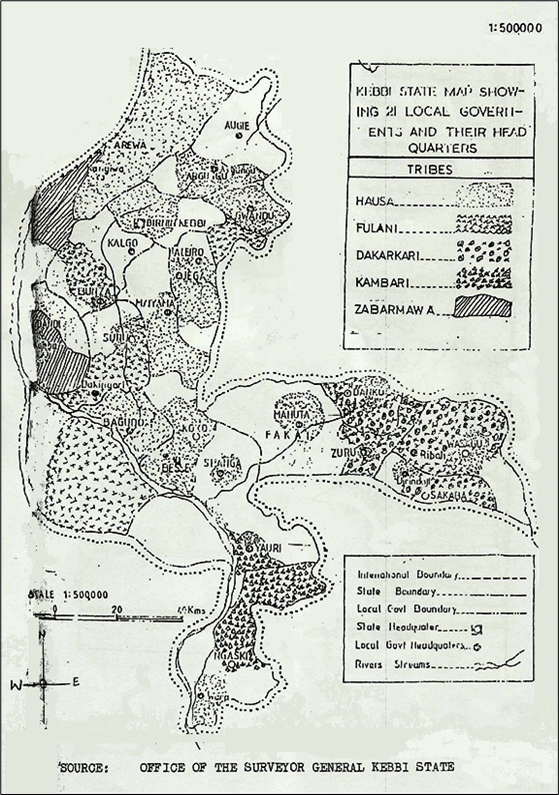
4Kebbi: The province of Kebbi was one of the provinces of Songhai Empire with its headquarters at Sawwa, now a village located a few kilometres from Gulma town in Argungu Emirate. During the reign of Askia Muhammad Toure who was popularly known as “Askia the Great”. Muhammad Kanta joined Askia’s warriors in about 1509 when the province was commanded by Magaji Dangara.1 While under Muhammad Kanta, Kabi was the strongest of the twelve provinces of Songhai.2 Muhammad Kanta led the army of the Songhai Empire to many victorious wars. It was also at a later time that Kanta overpowered Askia’s provincial commander, Dangara and became the strongest and first most powerful commander of Kabi province.
5In 1515 Kanta led Songhai Empire to a war between Songhai and Azbin. Songhai was victorious and Kanta was given a negligible share of the booty. Kanta was very much upset by this action and decided to break away from Songhai Empire. While returning to their base, at a place near Gao, Kanta told Askia that his (Kanta’s) province, Kabi, was no more a province under Songhai, but an Empire in itself with equal power and rights like that of Askia Muhammad. This showed the level of desire demonstrated by Kanta to establish his empire. Askia was not happy with the development and as a result there was a brief fighting. Kanta’s group got the support of Agades and Adar provinces to conquer Askia after seizing his sword. The skirmishes continued at different intervals up to 1553 when Askia made peace with Kanta.
6Kabi became an empire in the early 16th century and Kanta became the first king in 1515. He built three major administrative cities, namely ; Surame (the headquarters), Gungu (his army barracks), and Leka (the royal family quarters). These places are in the present Silame Local Government Area in the present Sokoto State. It is not far from Augi and Argungu Local Government Areas of Kebbi State. Kanta expanded the empire through various expeditions and conquests, to the east up to Nguru near Borno, to the west up to places near Timbuktu in Songhai Empire and to the north up to Azbin, in northern part of the Republic Niger and to the south up to Sagamu (in present day Ogun State) of old Oyo empire.3 Kabi Empire under Muhammad Kanta was therefore very powerful and vast. It was larger than present day Nigeria. Kanta`s revolt, mutiny and rising power was not left unchallenged by his former superior in Songhai and in the territories Kanta conquered. In order to take revenge of Kanta’s conquest over his area, the King of Azbin, Al-Adal, invited the King of Borno, Mai Ali, to help him attack Kebbi, purposely to kill Kanta and destroy his empire.
7The Kebbi Kingdom remained with its headquarters in Surame as it was up to the reign of the thirteenth King, Tomo son of Ibrahim son of Muhammad Kanta who moved the headquarters from Surame to Takalafiya, later known as Birnin Kebbi. Tomo built Birnin Kebbi meaning new capital city of Kebbi Empire in the eighteenth century in about 1725. He was 18 years old then. Since then, Birnin Kebbi remained the headquarters for 128 years. There was a prophesy that after 90 years, the site of the town will have to be changed otherwise the town would be captured in war.4 The empire collapsed in the 19th century during the reign of Kanta’s descendant Muhammad Hodi. The ruler Muhammadu Hodi and his advisers refused to adhere to the said prophesy which they dismissed as a mere myth hence the collapse of the empire.
8There were three major reasons that contributed to the fall of the empire. First, heavy drought which was at the fadama on which the entire population of Kabawa depended for rice cultivation and for fishing as well as other agricultural activities. The fadama provided food and income to the people. Second, factions among the royal houses. Each group had its own supporters. The families were fighting among themselves. This showed a clear lack of unity among the people and that easily gave way to smooth sailing of the intruders. The third was the Jihad. The coming of the Jihadists in 1805 was the final blow that crippled the Kingdom of Kebbi. The Jihadist took advantage of the disunity among the royal houses and launched an attack on Birnin Kebbi. Muhammad Hodi the then king of Kebbi intended to flee the town to Yauri. He actually started his journey to Yauri and was captured at Giwa Tazo near Jega and was killed. Another jihadist group followed his brother, Samaila, to Kaukau near Bachakar Tambo in Niger Republic and took away his small child, Yakubu Nabame to the Sultan’s palace in Sokoto. Yakubu grew up in Sokoto and became powerful soldier in the caliphate army. He succeeded in many battles like those of Zamfara and Gobir. In Zamfara, Yakubu defeated and beheaded their chief named Zakara da Gizo. Yakubu was also one of the Jihadists that destroyed Alkalawa a historical city of Gobir kingdom.
9While at Sokoto, Yakubu thought of reviving his ancestral kingdom. He sought for permission from the Sultan pretending to visit his relatives and left Sokoto. He heard that most of his people had left Birnin Kebbi and were scattered into small settlements. Some were made to work for Fulani at Gwandu like slaves. He went to Gudale in the present Bayawa/Tiggi area, he proceeded to Lailaba and realized that the people were taking thatch, wood and many other heavy objects as load to Gwandu for use by the Fulanis.5 Yakubu, unhappy with the situation solicited the co-operation of Zabarmawa, Arawa, Dakkarawa, Kyangawa and Adarawa and even some Fulani. Having maximum support, he built the present Argungu with the support of the various tribal groups around 1840 and made it the capital city of the revived Kebbi and declared himself the king of the new kingdom and gave it a status equal to that of Sokoto. He was attacked by Fulani from Sokoto and Gwandu with the sole aim of destroying his kingdom but they failed. He expanded the kingdom up to Filinge in the present Republic of Niger. Since then, Argungu was attacked by the Fulani for 41 years. During the reign of Sama son of Yakubu Nabame the fifth king of Argungu, a strong army was formed having sophisticated weapons to defend itself from attacks by Sokoto’s Sultan Abdulrahman Danyen Kasko. According to the myth, Kabawa prevented the people of Sokoto called Sakkwatawa from drinking anything liquid or water during the battle. As a result of the charm, the Sokoto people became weak and left by turning their backs. Sama and his army followed and killed many of the Sakkwatawa. Their war drums and weapons were seized. Very few of them escaped. Another attack (according to an oral source narrated by an informant at Kanta Museum in Argungu) in the same period, came from Gwandu at Alwasa. Three quarter of the Fulani population were killed, including their king, Haliru Abdu, whose head was cut off and brought before the king of Argungu, Sama. No Fulani man has ruled Argungu since its creation.6 Argungu remained a unit among several Kabawa areas over which Gwandu claimed superiority.
10However, with consolidation of power by the Jihadist in the 19th century under the leadership initiated by a famous Islamic scholar Shehu Usmanu Dan Fodiyo, the authority of Sokoto Caliphate was established over the land of Kebbi. This was made possible when the administrative leadership of the Caliphate was divided into two. Abdullahi Fodiyo, the brother of Shehu Usmanu Dan Fodiyo, became the leader of the western part with its administrative headquarters at Gwandu near Argungu, while the central part was headed by Muhammad Bello, the son of Shehu with its headquarters at Sokoto. From Gwandu town, the western capital of Fulani Jihadists was shifted to Ambursa town and later to Birnin Kebbi town that was once the headquarters of Kabawa. Birnin Kebbi is now the capital of Kebbi State. In spite of the Fulani Jihadists activities and the colonial rule, Argungu remains an emirate in Kebbi State just like Gwandu, Yauri and Zuru emirates.
11From the above narrations it is confirmed that the Zabarma people contributed significantly to the formation of the present Kebbi Kingdom. It is also to be noted that there are number of Zabarma people in the majority of local governments in Kebbi Sate. They are in Birnin Kebbi, Suru, Kalgo and Argungu and they constitute a reasonable number of the population.
12There exists a local government area in Kebbi State known as Dandi Local Government with its headquarters in Kamba. Kamba derived its name from a Zarma word meaning side gehe in Hausa. In Kamba the Zarma people were the original settlers and were letter met by the Kabawa,7 Hausawa and Fulani. There is a quarters known as Shiyar Zabarmawa in Kamba. The Zabarmawa were in the olden days fishermen and they welcome the settlers along the Dendi River, a contributory to the River Niger. Fishing was not the only activity along the Hoga Valley but salt scooping was another important economic activity.
13Other economic activities dominated by the Zabarma people in Kamba are sale of petroleum resource like petrol and diesel, Alhaji Sabi Kamba was prominent person in that area. There was Sabi Jula in the business of Building materials. Alhaji Tine and alhaji Zarmaganda specialised in currency exchange while Musa Dantarana and Abubakar Jawara are merchants. There are female Zabarmawa contributors to the economy in the area of grass weaving due to the availability of the raw material palm frond known as kaba in Kamba. Some of them are Hajiya Tani, Tawainiya, Zali, and Jimmo Alfa.
14In Birnin Kebbi town the capital of Kebbi Sate zabarmawa people were abound. There is particular location name after them, Shiyar Zabarmawa. There were many prominent personalities in the area some of which are businessmen and politicians. Sarkin Zabarmawa Alhaji Haliru was a prominent contractor.
15In Argungu Emirate there exist many villages and settlements occupied and traditionally ruled by Zabarmawa. In Argungu town there is Gwazange area and Gidan Kwali village. In Augie District Zabarma people occupies Tungar Mai-Rakumi,8 Bayawa has Tunar Rai rai while Lailaba has Ruggar Dan Magaji, Dambare and Unguwar Daura9 to mention just a few. There was a prominent Zarma politician in Lailaba known as Yawaiji Bazabarme who was said to have migrated from a Zarma village Bani Dai.
16There were Zarma people in government and politics of Kebbi State as well. Examples are Garba Musa Kamba the former Provost College of Education Sokoto and later Commissioner of Education Kebbi State, and Samaila Ganda speaker of Kebbi State House of Assembly, 10Alhaji Yakubu Bala Tafida Secretary to the Government of Kebbi State, and above all, the Governor of Kebbi State Dr Nasir Idris Kauran Gwandu.
There is the issue of disunity among Zabarmawa groups in terms of political leadership.
17This makes the Zabrmawa to be establishing settlements that can be ascribed to them and they preside over the newly established settlements. This usually happens when there was succession dispute among heirs of some villages and towns. However, there is a strong move by the major Zabarmawa leadership groups to unite the people for a better progress of the group.
Conclusion
18The relationship between the Sony people and that of Kebbi has been a long standing one. The people have an identified origin and social cum economic similarities involving language, religion, culture and economic enterprises. Zarma people are prominent in crafts, trading, working in the public and civil service, traditional leadership, and currency exchange The Zarma people in Kebbi have attained pollical positions in Kebbi including the highest office of Governor of the state among other exalted offices.
Notes de fin numériques :
1 . M.B. Alkali, “A Hausa Community in Crisis: Kebbi in the 19th Century”. (M.A. dissertation, ABU Zaria, 1969 ), 44. A detail study of origin ad migration of Kabawa tribe is available in Alkali’s work mentioned above. A copy is available in Sokoto State History Bureau and Ahmadu Bello University, Zaria, Library. Also, see Pathfinder International Magazines, March 2004, 34.
2 . M.B. Alkali, “A Hausa Community in Crisis….,” 54.
3 . J. Hatch, Nigeria: A History, 39. Alkali. “A Hausa Community in Crisis,” .173 further narrates how Sokoto Jihadists later conquered Kabi and Yakubu Nabame was taken hostage, how he grew up among the Fulani and how he later returned to Kabi and united his people who later defended themselves against the Fulani jihadists, up to the time of colonial conquest. Yakubu Bagaye, the head of Kanta Museum, Argungu also supports Alkali’s view.; H.F. Backwell., The Occupation of Hausa land 1900 – 1904: Being a Translation of Arabic Letters found in the House of Wazir of Sokoto, Bohari (Buhari ), in 1903, London: Frank Cass Co. Ltd, 1969, 13 – 14; Mohammad K. Jabo, “Modern Manufacturing Industry in Metropolitan Sokoto 1960 – 1990,” M.A. diss., Department of History, Usmanu Danfodiyo University Sokoto, 1992, p.36; Obaro, Ikime, Groundwork of Nigerian History, .73; Ajayi and Crowder, History of West Africa 1, .155; D.J.M., Muffet, Concerning The Brave Captains, London: 1964, 143 – 212); R. A. Adeleye, Power and Diplomacy In Northern Nigeria 1804 – 1906: The Sokoto Caliphate and Its Enemies, London: Longman, 1971, 279. Annual Report for Northern Nigeria (1903), Sa’ad Abubakar, “The Northern Province under Colonial Rule: 1900 – 1959,” in Groundwork of Nigerian History edited by Obaro Ikime, 469. The issue of colonialism and craft industries was also discussed in M.G. Smith, Government in Zazzau, London: 1960,163 – 166; A.T. Adamu, “Colonial Capitalism and Craft in Northern Nigeria: State Articulation in Sokoto Province, 1903 – 1960,” Ph.D. thesis, Stanford University, 1985, 21.
4 . NAK SNP K7039, Kebbi History and Legend.
5 . M.B. Alkali narrates how Yakubu Nabame was taken as hostage and how he grew up among Fulani.
6 . Interview with Yakubu Bagaye (Head, Kanta Museum), Argungu, 23rd March, 2007.
7 . An interview with Gali Muhammad, Kamba 6th March 2025.
8 . An interview Abubakar Muhammed Lamne Augie, Argungu, 6th March 2025.
9 . An interview with Isa Maitebur Lailaba, 6th March 2025.
10 . An interview with Garba Abdullahi Fana, 6th March 2025.
Pour citer ce document
Quelques mots à propos de : Atiku ABUBAKAR
Ph.D
Department of History and International Studies,
Federal University Birnin Kebbi, Kebbi State Nigeria
atikskebbi@gmail.com